Seasonal Guides Marine Guides in English Boat Maintenance
Bronze or Stainless Steel Seacocks? What to Fit Below the Waterline
Nafpaktos Marine Boatyard
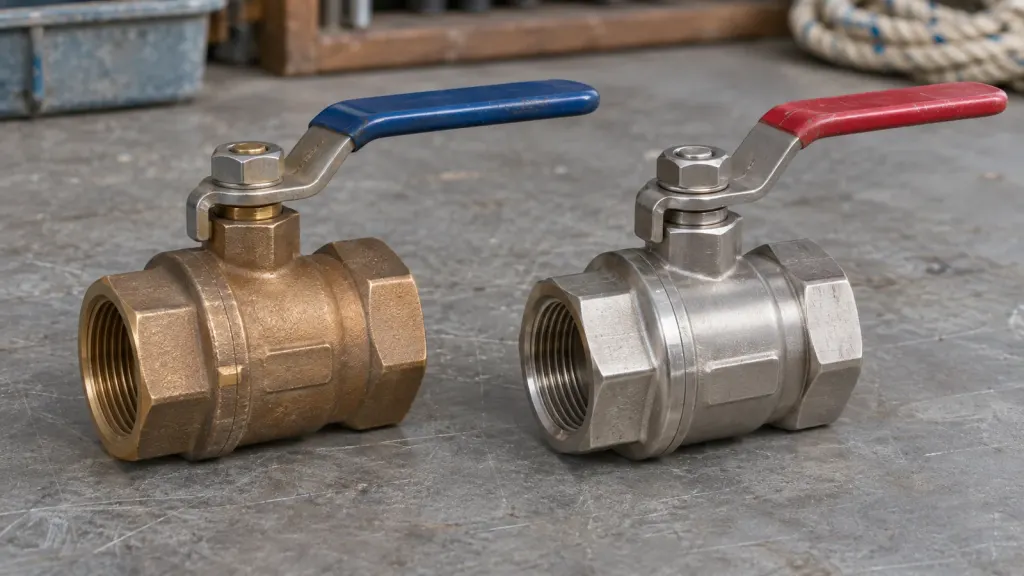
At our boatyard in Nafpaktos, owners regularly ask us which valves to fit below the waterline: bronze or stainless steel? Often, the question comes up during haul-out, when an old seacock needs attention and a shiny stainless replacement looks like an obvious upgrade.
It is a reasonable question. But below the waterline, appearance tells you very little. What matters is how the complete assembly withstands seawater, corrosion and mechanical loads.
Our recommendation: For a typical fibreglass boat kept in seawater, a properly specified marine bronze seacock system is a sensible default metal choice. Do not replace it with a generic 316 stainless steel valve simply because stainless sounds better. Purpose-built composite systems are another serious option.
This recommendation assumes suitable components, compatible threads and correct installation. Aluminium and steel hulls require a separate assessment of material compatibility, electrical isolation and corrosion protection. Do not install bronze fittings in direct electrical contact with an aluminium hull. Any use requires a properly engineered isolation and corrosion-protection arrangement.
Already have stainless steel seacocks? What to do now
Stainless steel alone is not a reason for panic or automatic replacement. A recommendation for a new installation is not a diagnosis of the valves already on your boat. Base the next step on the product’s suitability, installation, condition and service history.
- Identify what is fitted. Record the manufacturer, model, alloy and approximate age. If suitability or history is unknown, arrange an assessment rather than assuming either safety or failure.
- Operate and maintain according to the manufacturer’s instructions. Regular operation helps keep the mechanism free and can reveal stiffness. It does not guarantee that concealed surfaces are free of corrosion, nor reliably oxygenate every crevice. Never force a seized valve.
- Include the complete assembly in each haul-out inspection. For boats hauled annually, make this part of the annual routine. Investigate leakage, cracks, movement or changes in operation promptly; do not wait for the next scheduled lift.
- Plan replacement when assessment calls for it. Follow any manufacturer’s service-life guidance. Replace unsuitable or deteriorated components, and those whose condition cannot be established with sufficient confidence. Do not wait for visible leakage as the only trigger.
The practical approach is inspection and informed planning. There is no universal expiry date for every stainless valve, and routine maintenance alone cannot certify an existing installation as safe.
Which material should you choose?
| Material | What matters | Buying advice |
|---|---|---|
| Marine bronze | Exact alloy and intended application. | A strong default metal choice when documented for below-waterline seawater service. |
| Ordinary brass | Vulnerability to dezincification. | Avoid unspecified general plumbing valves for this critical application. |
| DZR brass | Verified alloy and suitability for seawater. | Choose a marine product with documented alloy, dezincification resistance and conformity to the applicable ISO 9093 requirements. |
| 316 / 316L stainless steel | Localised corrosion in seawater. | Require explicit suitability for the installation, rather than relying on the grade marking. |
| Purpose-built composite | Approved assembly and installation requirements. | A credible alternative. Ordinary plastic plumbing fittings are not equivalent. |
Bronze and brass can look similar. Ask for the material specification rather than judging by colour or the word “marine”. DZR means dezincification resistant: it identifies a useful property, not immunity to every form of deterioration.
Why stainless steel is not automatically better
Stainless steel performs well in many exposed marine applications. Permanent immersion creates different conditions.
The British Stainless Steel Association identifies pitting and crevice corrosion as limitations of 316 in seawater. Stagnation, deposits and tight crevices can encourage localised attack. Higher temperatures increase the risk of crevice corrosion.
That matters inside a valve, where threads, seals and deposits can create sheltered areas.
316L does not eliminate this problem. Its lower carbon content helps address an additional corrosion risk associated with welding; it does not make the alloy immune to pitting or crevice corrosion.
This does not condemn every stainless seacock. It explains why a generic “316” label is inadequate evidence of suitability.
Is your existing seacock safe?
Start with identification: manufacturer, model, material, installation date and service history. Then inspect the accessible assembly.
| What you find | What to do |
|---|---|
| Active water ingress | Treat it as an immediate problem. Use your emergency procedures and seek assistance. |
| Cracks, seepage or movement at the hull connection | Arrange prompt professional assessment. Avoid disturbing the assembly afloat. |
| A stiff, seized or damaged operating handle | Do not force it with an extension bar. Investigate the cause. |
| Pink or copper-coloured areas on a suspected brass fitting | Have it assessed for possible dezincification. Colour alone is not a diagnosis. |
| Heavy deposits or corrosion around joints | Investigate the underlying condition rather than simply polishing the surface. |
| No reliable material identification | Include identification and condition assessment in the next haul-out plan. Escalate sooner if there are warning signs. |
Dezincification removes zinc from brass and can leave a weakened, porous copper-rich structure. An apparently intact fitting may have lost strength.
A valve that turns freely has passed an operating check—not a structural inspection.
Afloat, limit checks to observation and normal operation where safe. Dismantling and examination of concealed surfaces belong in a controlled maintenance setting, normally during haul-out.
Check the whole assembly before buying
A sound valve cannot compensate for a weak through-hull or an unsuitable connection.
- Documented use: Is the product intended for below-waterline seawater service?
- Materials: What are the body, through-hull and hose fitting made from? Check the internal components too. A bronze body may legitimately contain a plated brass ball or stainless parts; assess the manufacturer’s complete design rather than assuming every component must be bronze.
- Threads: Do the thread standards match—not just the nominal size?
- Support: Is the assembly installed and supported according to its instructions, without unnecessary loads from hoses and fittings?
- Access: Can you reach, operate and maintain it?
Thread compatibility deserves particular attention. GROCO makes specific adapters to connect straight NPS through-hulls to tapered NPT valves, addressing a potentially dangerous mismatch. BSP connections also require correct identification; the same nominal size does not establish compatibility between thread systems.
A high pressure rating such as WOG does not, by itself, demonstrate suitability as an installed below-waterline seacock.
Will anodes or bonding solve corrosion problems?
Do not assume that adding an anode makes an unsuitable valve safe. Cathodic protection and bonding must be assessed as part of the boat’s overall installation. They cannot correct incompatible threads, inadequate support or metal that has already lost strength.
Follow the component manufacturer’s instructions and obtain qualified advice before changing the bonding arrangement. There is no useful universal instruction to “earth every valve”.
What about composite seacocks?
Purpose-built composite seacocks deserve consideration, particularly where avoiding metallic corrosion is valuable.
Products such as TruDesign use glass-reinforced nylon and are designed for above- and below-waterline applications. Check the exact model, size and required assembly: a support collar or other specified component may be necessary to achieve the stated load performance.
Corrosion resistance does not mean maintenance-free. Forespar explicitly makes this distinction for its Marelon systems.
What to ask your supplier
Ask for a suitable assembly, not simply “a bronze valve” or “an inox valve”.
Provide your hull material, existing fitting size, thread information and clear photographs. Request the exact material specification, below-waterline suitability and installation instructions.
For a typical fibreglass boat, documented marine bronze remains our default metal recommendation. Whatever you choose, the through-hull, valve and fittings must work together.
Need help identifying your installation? Send Nafpaktos Marine clear photos of the inboard assembly and any stamped markings. If the boat is already ashore, include the external through-hull flange. Photograph markings such as alloy codes, manufacturer names and size or pressure ratings—these are identification clues, not proof of suitability on their own.
Technical references
- GROCO: valve operation and maintenance guidance (BV series)
- British Stainless Steel Association: stainless steels in seawater
- AMPP: dezincification
- Guidi: materials in marine systems
- GROCO: bronze valve construction and seacock application
- GROCO: NPS-to-NPT flanged adapters
- TruDesign: composite marine ball valves
- TruDesign: assembly support and load-bearing collars
- Forespar: Marelon and routine maintenance

Marine Technician – Nafpaktos Marine founder
Marine engine specialist working with fishing vessels, charter boats and just about anything that floats.