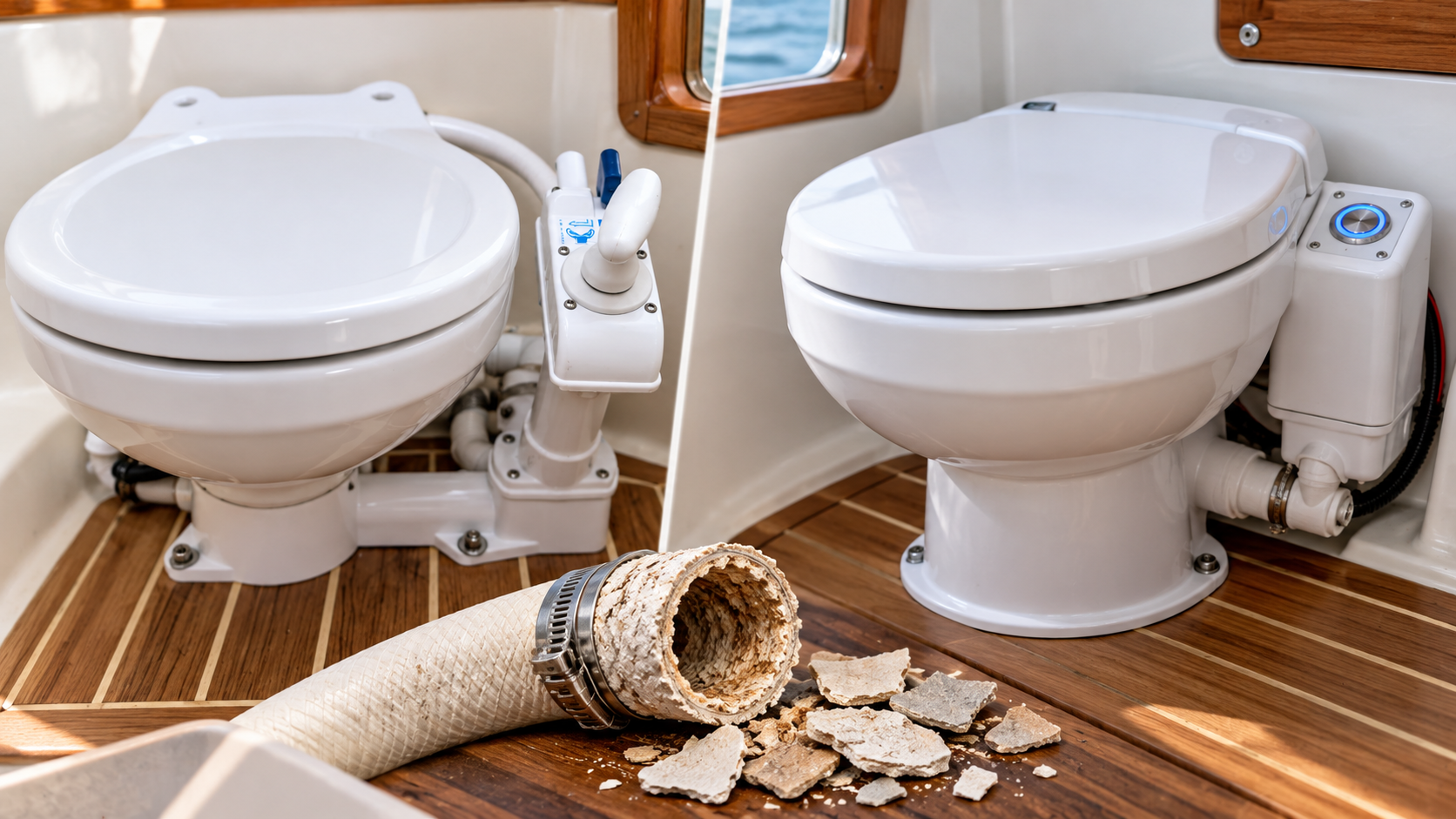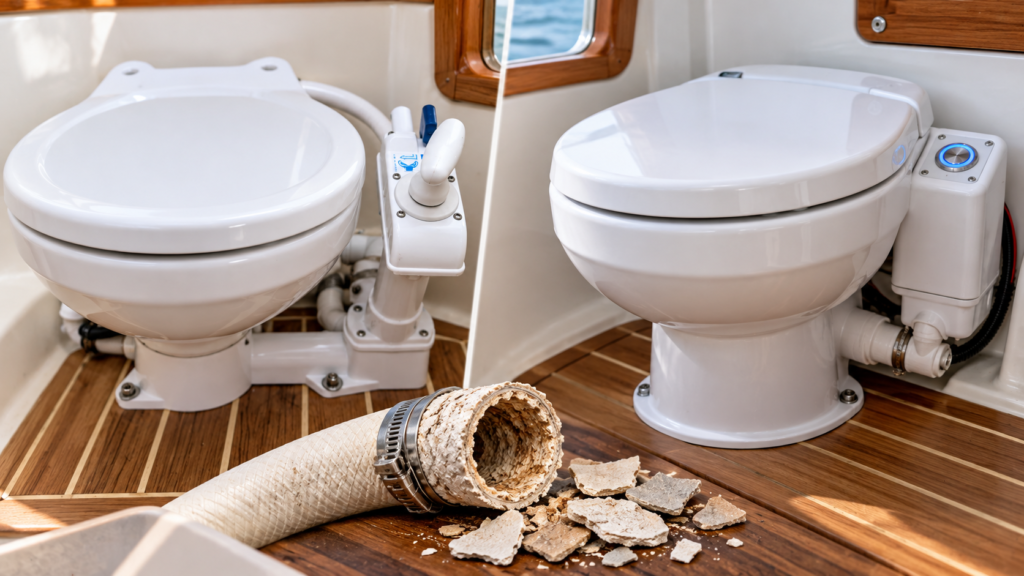
Manual or electric? At first glance, the choice seems obvious.
An electric marine toilet feels modern, familiar and effortless. Press a button and the job is done. A manual toilet, by comparison, may look almost old-fashioned.
But in practice, the choice is more complicated.
Marine toilet problems are often blamed on pumps, macerators, impellers or worn seals. Yet in many seawater-flushed systems we inspect, one of the most important problems is found somewhere else:
mineral scale building up throughout the waste path.
That changes the discussion considerably.
The question is no longer simply whether manual or electric flushing is more convenient. It also becomes a question of how much water enters the system, what kind of water is used and how much control the user has over the flushing process.
Manual vs electric marine toilet at a glance
| Feature | Manual | Electric |
|---|---|---|
| Ease of use | Needs a little instruction | Very easy |
| Mechanical complexity | Low | Higher |
| Electrical power | Not required | 12V or 24V required |
| Water control | Excellent | Depends on the system |
| Guest friendliness | Moderate | Excellent |
| Field repair | Usually straightforward | More components involved |
| Purchase cost | Usually lower | Usually higher |
Why electric marine toilets became so popular
The appeal is easy to understand.
An electric marine toilet works much more like the toilet people use at home. There is no pump handle and usually no wet/dry selector to explain.
For charter yachts in particular, this is a genuine advantage.
- Guests understand it immediately.
- There is less explanation during check-in.
- There is less chance of incorrect pumping technique.
- Push-button operation feels more appropriate on a modern or premium yacht.
When guests are paying several thousand euros for a week’s charter, convenience and perceived comfort matter.
From the guest’s point of view, electric toilets have a clear UX advantage.
Why manual toilets are still everywhere
Manual marine toilets remain popular for an equally convincing reason:
there is less to go wrong.
A manual toilet does not need an electric motor simply to flush the bowl. It generally involves fewer components, fewer electrical connections and no electrical circuit dedicated to normal flushing.
For cruising sailors and maintenance teams, that has obvious benefits:
- simpler troubleshooting,
- easier dismantling,
- fewer electrical faults,
- easier onboard repair,
- and generally lower replacement cost.
Simple does not necessarily mean primitive.
On a boat, simplicity often means reliability.
The advantage that is often underestimated: water control
One of the most useful advantages of a manual marine toilet is the direct control it gives the user over flushing water.
With many basic electric systems, pressing the switch automatically introduces a predetermined amount of seawater into the bowl.
The inlet flow can sometimes be reduced at the seacock, but that is not a practical way to adjust every individual flush.
With a manual toilet, water quantity can be controlled immediately:
- Need only a little water? Use a few pump strokes.
- Need more? Keep pumping.
- Want the bowl almost dry? Stop introducing water and pump it out.
- Want to rinse with fresh water? Add a small amount manually and pump it through.
The important difference: the flushing volume is controlled directly by the user rather than entirely by a preset cycle.
Why water quantity matters
This is where the subject becomes more important than simple convenience.
In seawater-flushed marine sanitation systems, urine and seawater can contribute to the formation of hard mineral deposits inside the waste path.
Over time, deposits can accumulate inside:
- discharge hoses,
- joker valves,
- non-return valves,
- elbows and fittings,
- holding-tank plumbing,
- and waste-pump connections.
A sanitation hose may look perfectly normal from the outside while becoming heavily restricted internally.
Typical symptoms can include:
- harder pumping,
- slower discharge,
- poor valve sealing,
- reduced effective hose diameter,
- macerator problems,
- and eventually a complete blockage.
Flushing water is not just there to clean the bowl.
It influences what happens throughout the entire sanitation system.
What we commonly find during service
When a marine toilet begins to perform poorly, the first suspicion is often mechanical wear.
The usual suspects are familiar:
- the macerator,
- the impeller,
- rubber components and seals,
- the pump mechanism,
- and other normal service parts.
In many systems, however, dismantling reveals a different picture.
The mechanical components may still be perfectly serviceable while the waste path is heavily restricted by mineral deposits.
Scale can accumulate around valves, fittings and moving components, and can progressively reduce the internal diameter of discharge hoses.
This is why replacing individual parts without inspecting the complete sanitation route can sometimes fail to solve the underlying problem.
Poor toilet performance does not automatically mean a worn-out toilet.
Before replacing motors, pumps, macerators or service kits, the entire discharge route should be inspected for restriction and scale.
A striking example from a privately owned sailing boat
One recent privately owned sailing boat provided a particularly clear example of how quickly this problem can develop.
The boat was not commercially operated and had seen relatively little seasonal use:
- approximately three weeks during the first season,
- and about one month during the second season.
The electric toilet was dismantled during service because its poor performance initially suggested that normal wear components might need replacement.
Instead, the macerator, impeller, rubber parts and other mechanical components were found in very good condition.
The significant restriction was caused by mineral scale throughout the waste path, not by worn mechanical parts.
The amount of scale was particularly notable given the limited private use of the boat.

What a 25 mm sanitation hose can hide
Small-diameter discharge plumbing is particularly sensitive to internal restriction.
A 25 mm hose may appear completely normal externally while thick deposits progressively reduce the space available for waste to pass through.
Once the deposits become sufficiently thick, the symptoms can easily be mistaken for:
- a weak pump,
- a failing macerator,
- a worn impeller,
- or a defective valve.
In reality, the pump may simply be trying to force waste through a passage that has become much smaller than its original diameter.
The freshwater trick
This is where precise control over flushing water becomes especially useful.
With a manual toilet, using a small quantity of freshwater occasionally does not necessarily mean wasting litres from the boat’s tanks.
A quantity roughly equal to a drinking glass can provide a useful freshwater rinse through part of the discharge system.
The idea is simple:
- less seawater remains inside the sanitation system,
- urine is diluted and moved farther through the plumbing,
- and the conditions favouring mineral deposit formation can be reduced.
Fresh water is not a magic cure for scale and it does not replace proper inspection or maintenance.
But using a small amount intelligently may be far easier than dealing later with a heavily restricted sanitation hose.
Important: freshwater used for toilet flushing must never be connected in a way that could allow contamination or backflow into the boat’s potable water supply.
Does this mean electric toilets cause more scale?
No.
That would be too simplistic.
Scale formation depends on several factors:
- the use of seawater,
- urine,
- flushing volume,
- plumbing layout,
- how long waste remains inside the system,
- and maintenance habits.
Some modern electric toilets provide excellent control, including selectable flush cycles, dry-bowl modes or dedicated freshwater flushing.
So the most useful question is not simply:
“Manual or electric?”
It is:
How much control does this particular toilet give the user over the flushing water?
Manual or electric for a charter yacht?
For charter companies, the decision is not as simple as it first appears. The guest and the maintenance team look at the same toilet from completely different perspectives.
| For the charter guest | For the maintenance team |
|---|---|
Electric usually wins on convenience.
Best advantage: | Manual usually wins on simplicity.
Best advantage: |
Electric improves the guest experience. Manual improves mechanical simplicity.
What changed after replacing one electric toilet with a manual unit
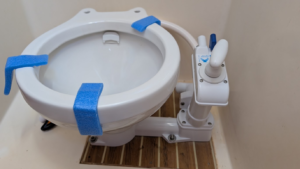
In the privately owned sailing boat described above, the electric toilet was eventually replaced with an Osculati manual marine toilet.
The unit is simple, affordable and straightforward to service.
But the most interesting benefit was not its purchase price.
The owner found that manual operation gave much more direct control over the flushing process:
- the quantity of seawater entering the bowl can be minimised,
- the bowl can be pumped almost dry when required,
- unnecessary flushing water can be avoided,
- and a small quantity of freshwater can easily be added for an occasional rinse.
That experience reinforces a broader point that applies to many marine sanitation systems:
Control over flushing water can be just as important as the flushing mechanism itself.
Do not blame the toilet too quickly
If a marine toilet becomes difficult to flush or discharge, the toilet itself may not be the real problem.
The restriction can be farther downstream.
Before replacing expensive components, inspect:
- the discharge hose,
- the joker valve,
- non-return valves,
- elbows and fittings,
- holding-tank connections,
- and the waste pump.
A hose that looks perfectly healthy externally can be heavily restricted internally by mineral deposits.
If the boat uses a holding tank and powered discharge system, the macerator waste pump and its associated plumbing should also be included in routine inspection.
So which marine toilet should you choose?
Choose electric if:
| Choose manual if:
|
Final thought
The best marine toilet is not necessarily the most sophisticated one.
It is the one whose operation is understood, whose plumbing can be maintained and whose behaviour remains predictable when something goes wrong.
Sometimes a push button is exactly what a boat needs.
And sometimes a simple hand pump provides something equally valuable:
control.
Frequently asked questions
Are manual marine toilets more reliable than electric toilets?
Manual toilets generally contain fewer electrical and mechanical components, which makes troubleshooting and onboard servicing simpler. Reliability still depends on correct installation, maintenance and proper use.
Do electric marine toilets cause more scale?
Not simply because they are electric. Scale formation is mainly related to seawater, urine, flushing volume, plumbing design and maintenance. Some electric toilets provide excellent control over flushing water.
Can I flush a marine toilet with fresh water?
Freshwater rinsing can be useful, but it must be introduced in a way that cannot contaminate the boat’s potable water supply. Never create a plumbing arrangement that allows toilet water to backflow into drinking-water lines.
Why does a manual marine toilet become difficult to pump?
Possible causes include worn pump components, damaged valves, mineral scale, blocked discharge hoses or restrictions farther downstream in the sanitation system.
Can mineral scale make an electric toilet appear to be faulty?
Yes. Restricted hoses, valves and fittings can reduce performance even when the motor, macerator, impeller and other service components remain in good condition. Inspecting the entire sanitation system is therefore important before assuming that the toilet itself has failed.
Can a marine toilet discharge hose be blocked even if it looks normal outside?
Yes. Mineral deposits form on the inside of the hose and can progressively reduce its effective diameter without causing any obvious external change.
Is a manual marine toilet suitable for a charter yacht?
Yes. Manual toilets remain widely used on sailing yachts and charter boats. Their main disadvantage is that inexperienced guests normally need a short explanation before using them.
Is an electric marine toilet better for charter guests?
Usually yes from a usability point of view. Push-button operation is familiar and requires less explanation. The trade-off is greater mechanical and electrical complexity for the operator or maintenance team.

Marine Technician – Nafpaktos Marine founder
Marine engine specialist working with fishing vessels, charter boats and just about anything that floats.